
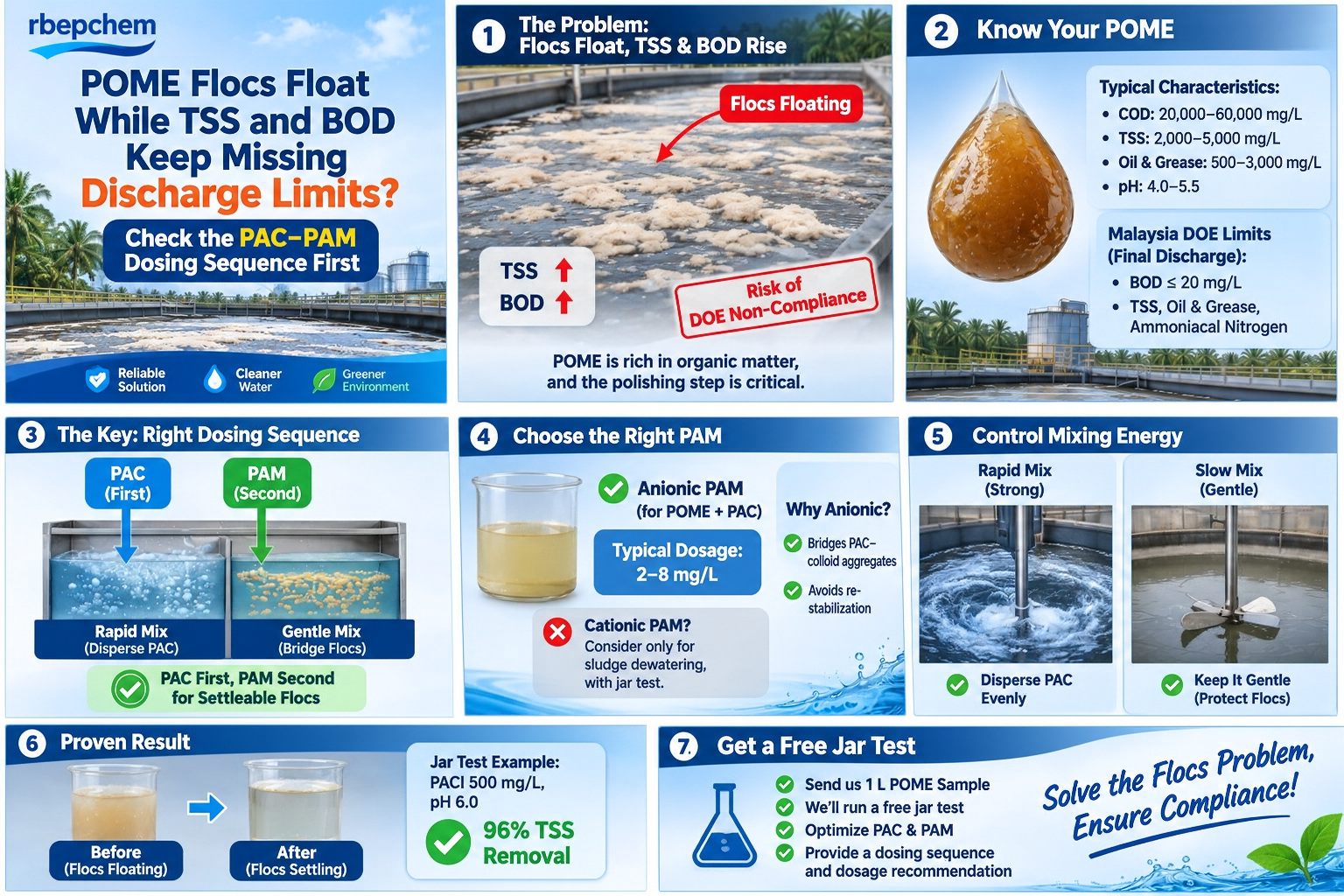
POME is not a forgiving stream. It arrives at the treatment plant with COD in the range of 20,000–60,000 mg/L, TSS at 2,000–5,000 mg/L, oil and grease at 500–3,000 mg/L, and a pH sitting between 4.0 and 5.5. Malaysia’s Department of Environment requires final discharge BOD at or below 20 mg/L, with separate limits on TSS, oil and grease, and ammoniacal nitrogen. Biological treatment handles the bulk of the organic load, but when the polishing step fails—flocs floating, solids escaping—the whole train is judged by what leaves the outfall. Coagulation and flocculation are often the last controllable lever before discharge, and they are frequently the lever being pulled in the wrong direction.
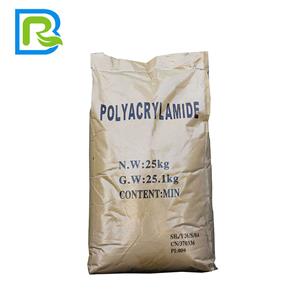
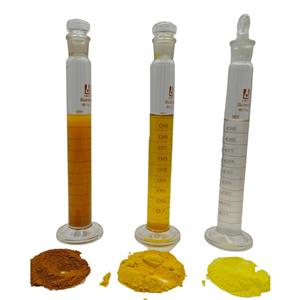
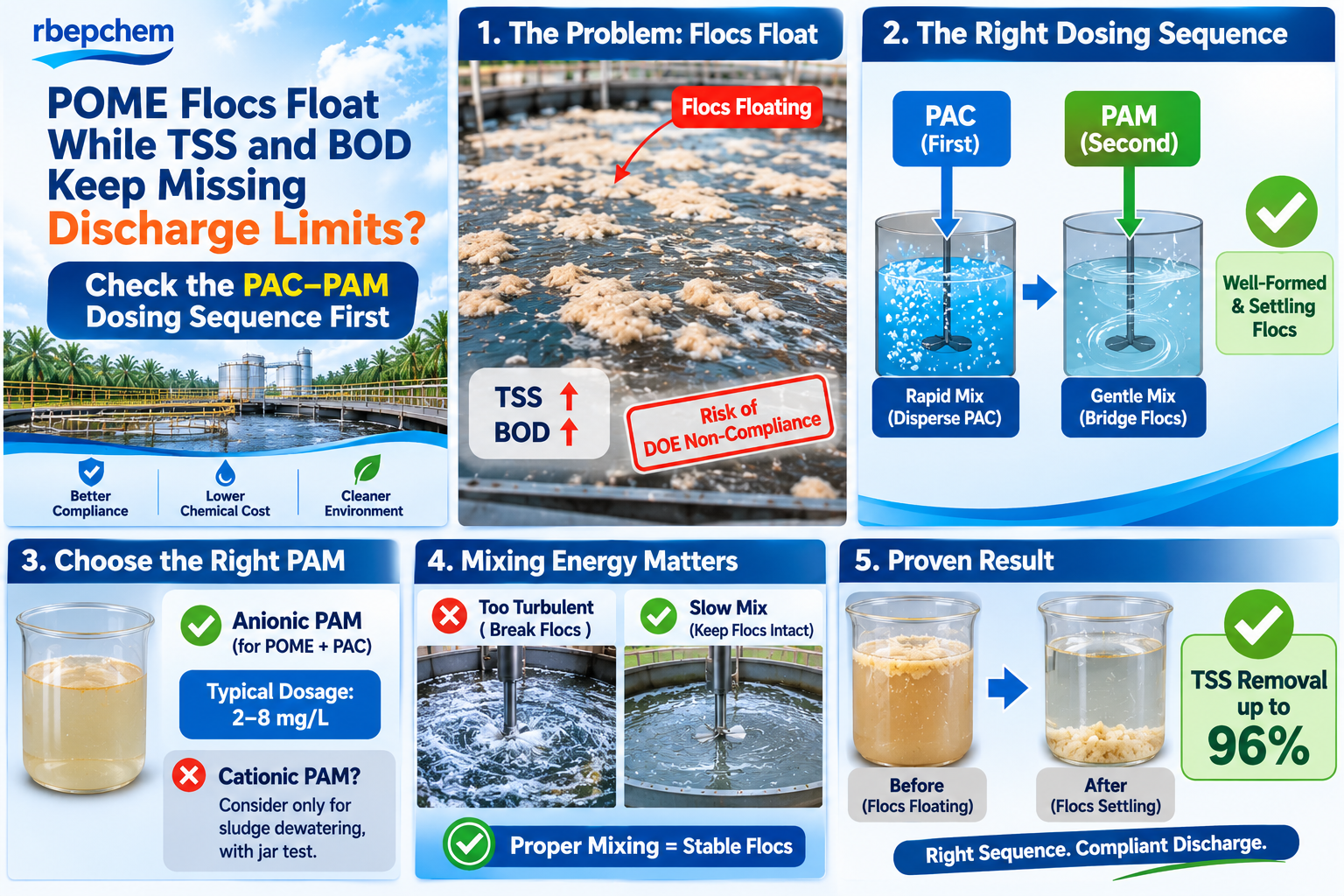
The first thing to check is not dosage. It is sequence. PAC must contact the waste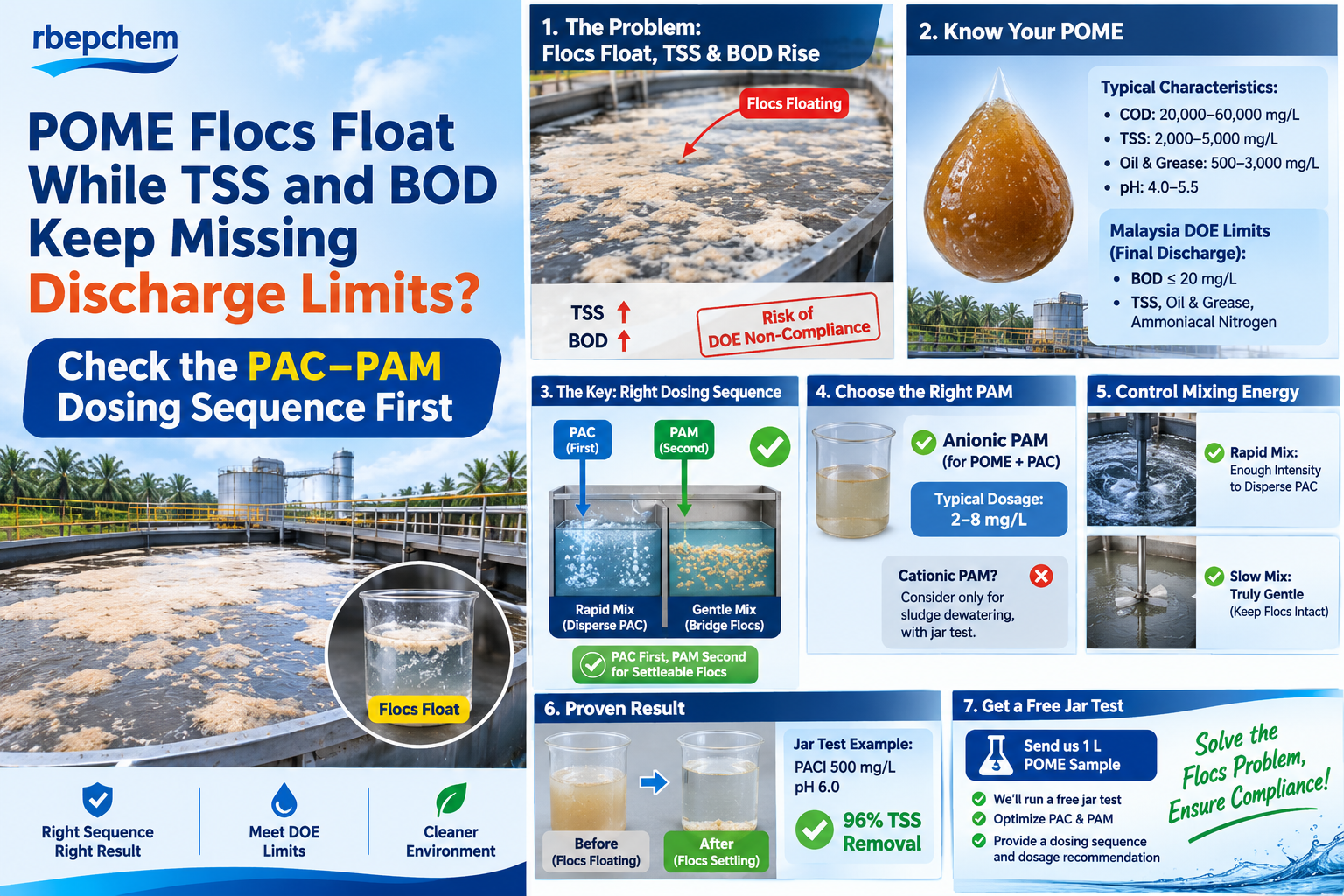 water first, under rapid mixing, so that the colloidal charge is neutralized and micro-flocs begin to form. PAM is added second, under gentle mixing, to bridge those micro-flocs into settleable aggregates. If PAC and PAM are introduced too close together—or if PAM goes in first—the polymer wraps around particles that have not yet been destabilized. The bridge forms, but it bridges the wrong things. Flocs grow light and irregular, trap oil and gas, and float. The PAC’s charge-neutralization capacity is spent before it can do its job.
The second check is PAM ionicity. POME carries a heavy load of organic colloids and emulsified oil. Anionic PAM is the practical starting point for POME when paired with PAC, at typical dosages in the 2–8 mg/L range after the coagulant step. The anionic chain bridges the positively charged PAC–colloid aggregates without re-stabilizing the suspension. Cationic PAM has its place—sludge dewatering, for instance—but using it as a primary flocculant in POME without a jar test to confirm the charge demand is a common and expensive mismatch.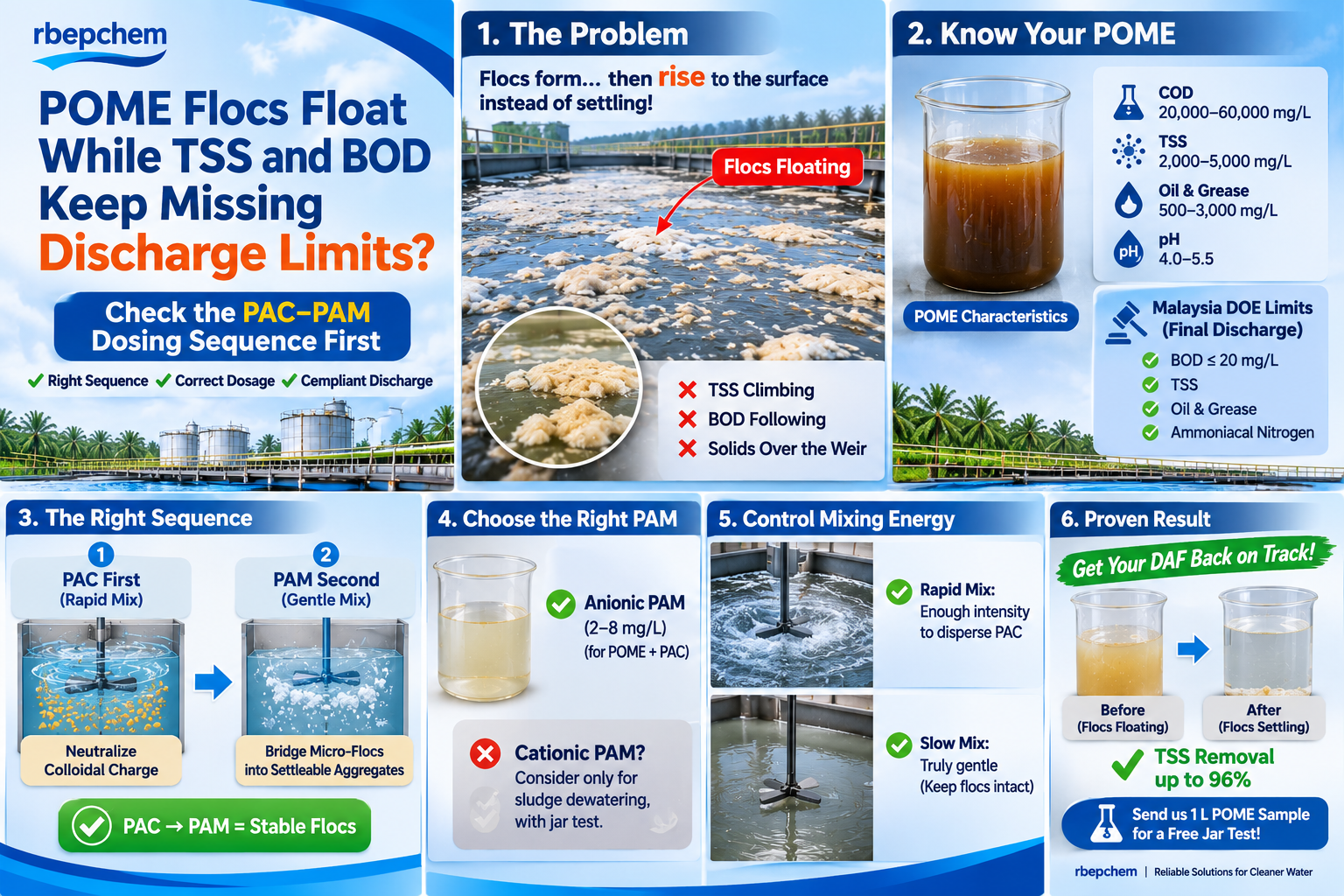
The third check is mixing energy. Rapid mix needs enough intensity to disperse PAC throughout the stream, but slow mix after PAM addition must be genuinely slow. If the slow-mix zone is too turbulent, the polymer bridges are sheared apart as quickly as they form. Broken flocs do not re-form. They leave as pin flocs in the effluent.
A simple adjustment sequence—PAC first under rapid mix, PAM second under gentle mix, with the correct anionic grade and a dosage confirmed by jar test—can move a DAF unit from “flocs floating and TSS unstable” to “flocs settling and discharge within limit” without adding a single kilogram of extra chemical. In one mill’s jar-test run, PACl alone at 500 mg/L and pH 6.0 achieved 96% TSS removal; the failure at full scale was not the chemistry, but how the chemistry was applied.
If your DAF or polishing unit is producing flocs that float instead of settle, send us a 1 L POME sample. We will run a free jar test, screen PAC basicity and PAM ionicity against your actual water, and return a dosing sequence and dosage recommendation—not a catalog.